Cornhole Rules: Scoring, Setup and Fouls for Backyard and League Play
A clear Canadian guide to cornhole setup, scoring, fouls and league notes, with practical house-rule tips for cottages, weddings, parties and rec play.
By Custom Cornhole Canada · · 6 min read
The quick version for a normal game
For most backyard games, cornhole rules are simple: set the boards 27 feet apart from front edge to front edge, take turns throwing four bags per team, score 3 points for a bag in the hole and 1 point for a bag on the board, then use cancellation scoring. Play to 21, unless your group agrees on a different target before the game starts.
A standard game uses eight bags, four in each of two colours. Partners stand at opposite boards, while singles players throw from one end and then walk to the other. The rules below are practical for cottages, driveways, weddings, company events and rec nights. For sanctioned play, always defer to the current ACL or ACO rule book for the event you are entering.
Cornhole rules for setup and cornhole distance
The standard adult cornhole distance is 27 feet from the front edge of one board to the front edge of the other board. Do not measure from hole to hole or from the back legs. Use a tape measure if you want a fair game, especially at a league night or tournament. On grass or uneven cottage ground, check that both boards sit flat before you start.
If you are playing with kids, newer players or guests in winter boots at a holiday event, it is fine to move the boards closer. Just make the change before the game and use the same distance for both teams. Many casual groups mark a shorter junior line, then keep the 27-foot line for adults and experienced players.
Leave room beside each board for the pitching area. Players should be able to stand safely without stepping into furniture, fire pits, tent ropes or spectators. If you are setting up for a wedding or event, keep the throw lane clear and place boards where stray bags will not hit a bar, gift table or walkway.
How to play cornhole: turns, innings and pitching area
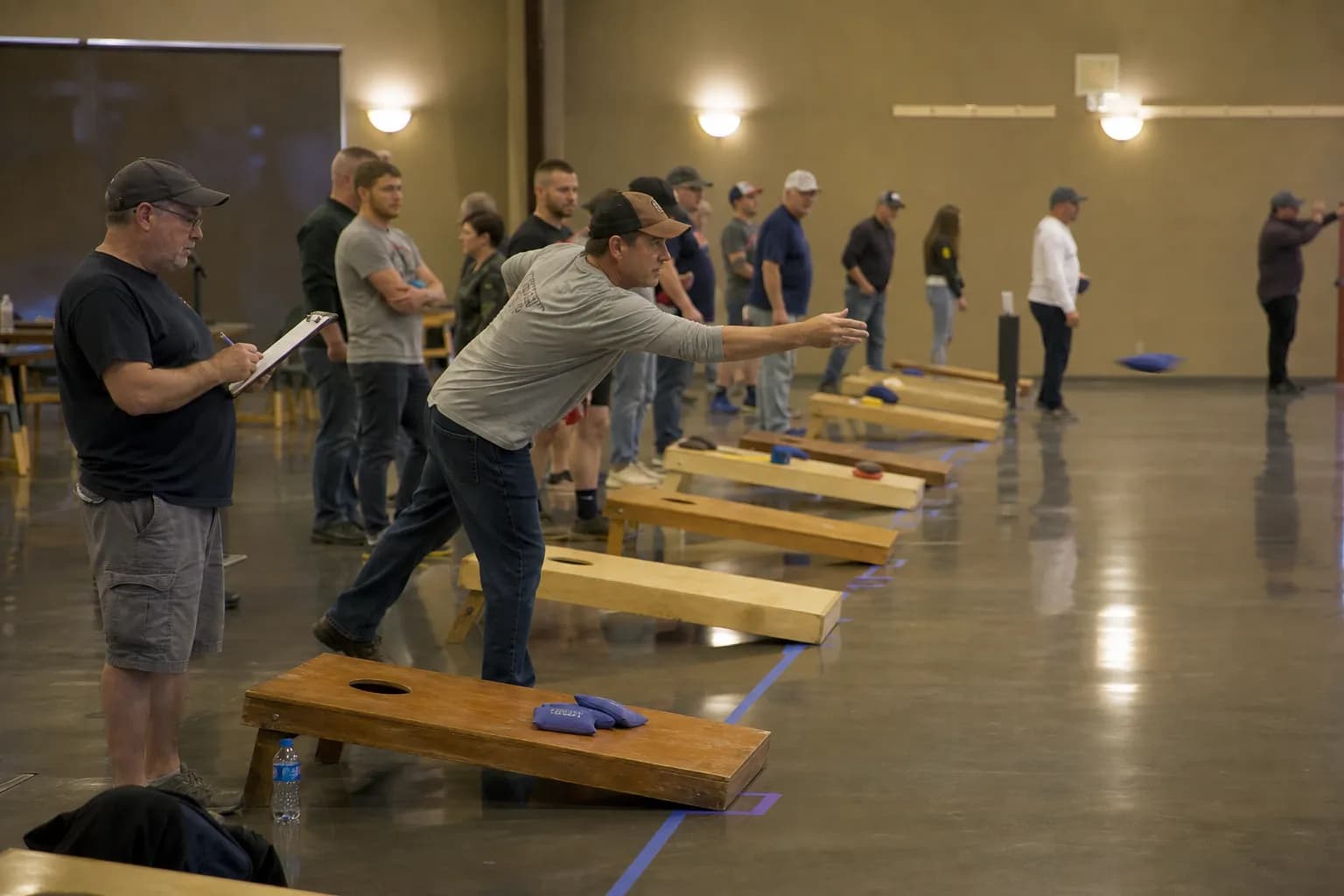
An inning is one round where all eight bags are thrown. One player from each team stands at the same end, beside the board, and they alternate throws until each has thrown four bags. Then you score that end. If playing doubles, the partners at the far board throw the next inning back the other way.
The team that scored in the previous inning usually throws first in the next inning. If nobody scored, the same team that threw first in the last inning can throw first again, unless your house rules say otherwise. For the first inning, use a coin toss, rock-paper-scissors or any fair method that suits your group.
For casual play, treat the front edge of the board as the foul line. A player should release the bag before stepping past that line. In official play, the exact pitching boxes, order of play, timing rules and player conduct rules may be more detailed, so use the tournament rule book if the match matters.
Cornhole scoring: 3 points, 1 point and cancellation
Cornhole scoring starts after all eight bags have been thrown in the inning. A bag through the hole is worth 3 points. A bag resting on the board at the end of the inning is worth 1 point. A bag on the ground is worth 0 points, even if part of it is leaning against the board.
Most games use cancellation scoring. Add each team’s points for the inning, then subtract the lower score from the higher score. Only the difference is added to the winning team’s total. For example, if red scores 7 and blue scores 4, red gets 3 points for that inning. This keeps the score moving without both teams adding points every round.
Casual games usually play to 21 or more, meaning the first team to reach at least 21 after a completed inning wins. Some groups use house rules such as playing exactly to 21, going back to a lower score if you go over, or needing to win by 2. Those are not universal cornhole rules, so agree on them before the first throw.
Fouls, dead bags and common judgement calls
A foul is a throw that should not count. Common fouls include stepping past the foul line before releasing the bag, throwing out of turn, throwing from outside the agreed pitching area, or taking a throw after a time or order rule has been broken in league play. In backyard games, call fouls clearly and calmly so the game stays friendly.
A dead bag is removed from play and scores 0. The most common dead bag is one that hits the ground first, then bounces onto the board. A bag that lands on the board but is touching the ground should also score 0. If a bag hits a chair, person, tree root or other object before landing on the board, the cleanest house rule is to call it dead and re-set any disturbed bags as fairly as possible.
Do not move or sweep bags from the board until the inning is finished, unless everyone agrees a dead bag must be removed. A bag hanging in the hole is still live if it is resting on the board and not touching the ground. If another bag knocks it in later during the same inning, it scores 3.
Backyard, cottage, wedding and event house rules
House rules are useful as long as everyone knows them. At a cottage, you may need to shorten the distance because of a dock, slope or tree. At a wedding, you may want shorter games to keep guests rotating. At a company picnic, you may want a simple bracket with one-game matches to 21 so the event stays on schedule.
For weddings and parties, use signs or a score sheet so guests do not need to ask the same rule questions all night. A standard set is easy to explain: four bags for one side, four for the other, throw all eight, score the difference. If you want matching bags for a celebration, Custom Wedding Cornhole Bags and Cornhole Bags for Parties and Events are common starting points.
Custom Cornhole Canada makes custom printed cornhole bags, not boards. Designs can include names, monograms, logos, photos or patterns, and the ink goes into the fabric through full dye-sublimation, so the printed artwork does not crack, peel or rub off. If you have a logo or photo, you can attach it when you Start your design (free proof).
League play, official rule books and bag choices
League nights need tighter rules than a backyard game. Organizers should post the distance, scoring method, match format, playoff format and any time limits before play starts. If your league follows ACL or ACO rules, use that rule book as the final word for equipment, court layout, player conduct, fouls, timeouts and tie situations.
Bag rules can matter in organised play. Official groups may define size, weight, construction and other details, and event directors may inspect bags. If you are ordering for a team or rec league, tell us what the bags are for on the design form and we will confirm what we can make. Do not assume a custom bag is approved for a sanctioned event unless the event director confirms it.
A standard set is eight bags, four in each of two colours, and each colour can carry a different design. Teams often use logos, names or simple colour blocks so bags are easy to tell apart during scoring. Useful examples include Team and League Cornhole Bags, Logo Cornhole Bags for Businesses and Regulation Cornhole Bags.
Questions
How far apart are cornhole boards?
For standard adult play, cornhole boards are 27 feet apart, measured from the front edge of one board to the front edge of the other. For kids, new players or tight backyard spaces, you can move them closer as a house rule. For official play, check the ACL or ACO rule book used by your event.
How does cancellation scoring work?
After all eight bags are thrown, count each team’s points for that inning: 3 for a bag in the hole and 1 for a bag on the board. Subtract the lower score from the higher score. Only the difference is added to the winning team’s total for that inning.
Do you have to win cornhole by 2?
Most casual cornhole games do not require winning by 2. The usual backyard rule is first team to reach 21 or more after a completed inning wins. Some leagues or house rules add win-by-2, exact-21 or bust rules, so confirm before the game starts.
What is a foul in cornhole?
A foul is a throw that does not count, such as stepping past the foul line before release, throwing out of turn or throwing from outside the agreed pitching area. A bag that hits the ground and bounces onto the board is also treated as dead and scores 0. Official events may define fouls in more detail, so use the event rule book.
More: Regulation Cornhole Bags